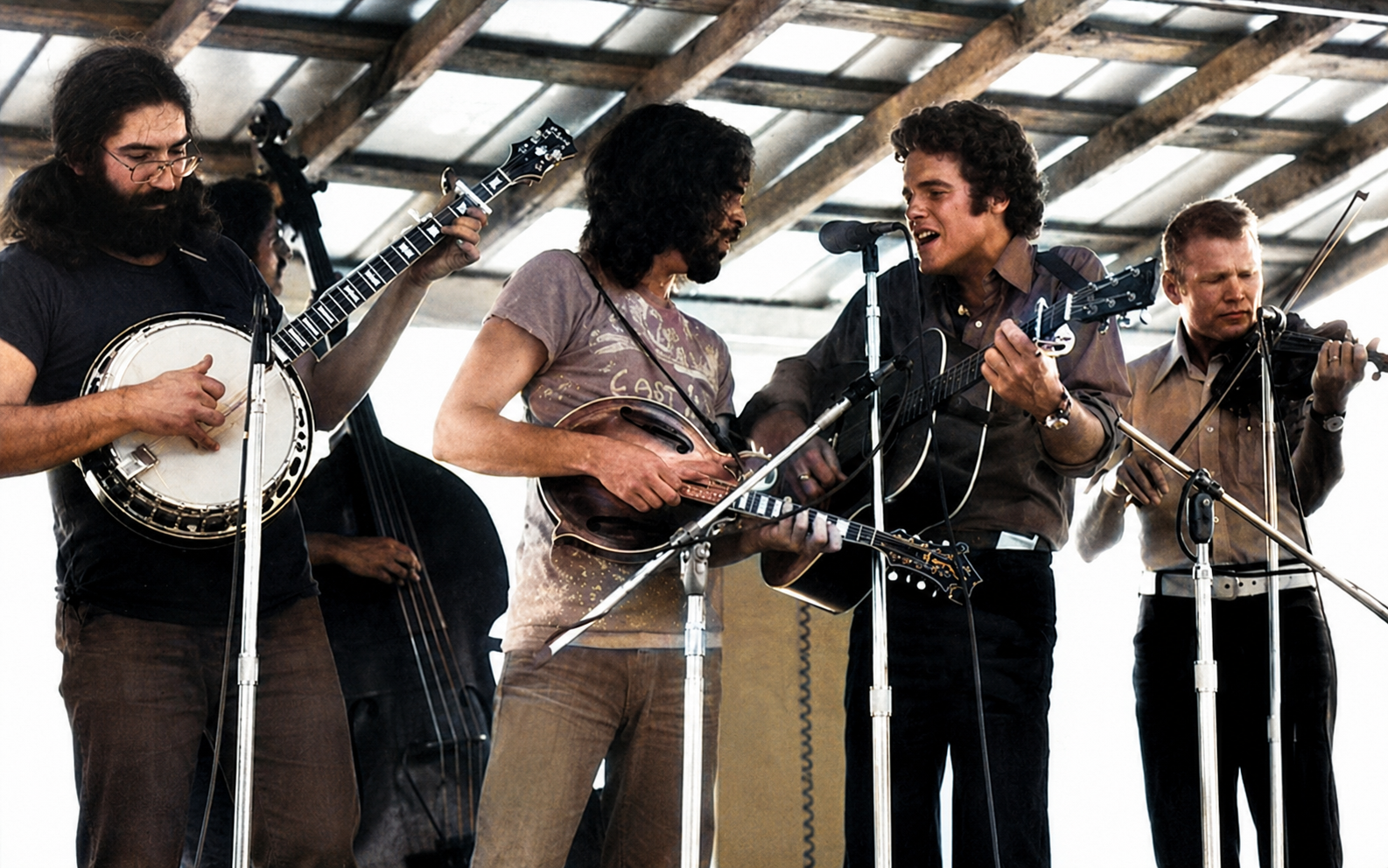
Old & In the Way at the Record Plant — March 2, 1973
March 2, 1973 — KSAN Broadcast, Record Plant Sausalito
By Tom Proctor
In early 1973, a new bluegrass band was taking shape in Marin County.
Jerry Garcia was living in Stinson Beach and playing banjo whenever his schedule with the Grateful Dead allowed. David Grisman was nearby, as was guitarist and singer Peter Rowan, a veteran of Bill Monroe's Blue Grass Boys. Bassist John Kahn, already one of Garcia's closest musical collaborators outside the Dead, completed the core quartet.
The setting was remarkably informal. This wasn't a band assembled by a record company or built around plans for an album. It grew out of musicians living near one another and getting together to play.
John Kahn later remembered rehearsals at Garcia's home in Stinson Beach and at his own place in Forest Knolls. Garcia and Grisman had already been playing bluegrass together around Stinson Beach in late 1972, and as Rowan and Kahn became involved, the gatherings gradually turned into something more serious. There are recollections of the four playing in a small Stinson Beach bar before the group began appearing at established venues, although the details and dates of those informal performances have never been firmly documented.
It is an appealing picture of Old & In the Way's beginnings: four musicians sitting around Marin County playing acoustic music because they wanted to, with no particular indication yet of how important the band would become.
From Stinson Beach to Sausalito
On March 2, the quartet arrived at the Record Plant in Sausalito for a live performance broadcast by KSAN.
The lineup that day was still just four musicians:
- Jerry Garcia — banjo, vocals
- David Grisman — mandolin, vocals
- Peter Rowan — guitar, vocals
- John Kahn — acoustic bass
There was no fiddle.
That alone makes the March 2 recording an interesting document. The familiar Old & In the Way sound would eventually include a fifth voice, first with fiddler Richard Greene and ultimately with the great Vassar Clements. But on this afternoon at the Record Plant, the music was stripped down to banjo, mandolin, guitar, bass and voices.
The group played nine songs:
- Goin' to the Races
- Dark Hollow
- Katie Dear
- New Camptown Races
- Two Little Boys
- Home Is Where the Heart Is
- Down Where the River Bends
- Knockin' on Your Door
- Blue Grass Breakdown
The repertoire is revealing. These aren't yet the songs most listeners would later associate with Old & In the Way. There is no "Panama Red," "Midnight Moonlight," "Lonesome L.A. Cowboy," "Land of the Navajo" or their bluegrass treatment of the Rolling Stones' "Wild Horses."
Instead, the Record Plant performance is rooted deeply in traditional bluegrass.
Even the final instrumental has accumulated a little history of its own. It has sometimes circulated under the title "Old & In the Way Breakdown," but careful listening to the broadcast identifies it as Bill Monroe's "Blue Grass Breakdown."
The tape therefore captures something more interesting than an early version of a finished band. It captures the musicians while they were still finding out what the band could be.
Garcia Goes Back to the Banjo
For listeners who knew Jerry Garcia primarily from the Grateful Dead, hearing him in this setting must have been striking. But the banjo wasn't a novelty for Garcia.
Years before the Dead, he had been deeply immersed in folk and bluegrass music, playing banjo in groups including the Black Mountain Boys and spending years absorbing the playing of Earl Scruggs and other bluegrass musicians. The electric music that made Garcia famous had partly grown out of that earlier acoustic world.
Old & In the Way gave him a way back into it.
And he was doing it while the Grateful Dead were extraordinarily busy. In fact, Garcia had just returned with the Dead from a Midwest tour. They had played their final show of the trip in Salt Lake City on February 28. On March 2, Garcia was already at the Record Plant in Sausalito with a banjo in his hands.
Later that same day, Old & In the Way headed north to the Lion's Share in San Anselmo.
Contemporary newspaper listings advertised the band there on March 2 and 3 with the Rowan Brothers. A Rolling Stone writer, John Grissim, caught the group at the Lion's Share and later described a wonderfully human moment: Garcia started a banjo solo before realizing that his instrument wasn't plugged into the amplifier. He simply stepped toward the microphone and kept playing.
It is difficult to imagine a better snapshot of the group at this stage — accomplished musicians, but still new enough as a band for things to be a little loose around the edges.
Bluegrass on KSAN
There is another part of the March 2 recording that is easy to overlook today: this was being broadcast on KSAN.
KSAN was one of the defining free-form FM stations of the Bay Area. Its audience was accustomed to the Grateful Dead, psychedelic rock, singer-songwriters and the enormous range of music that characterized progressive FM radio in the early 1970s.
And suddenly here was Garcia playing banjo in an acoustic bluegrass quartet.
The Record Plant was particularly well suited to these broadcasts. Instead of trying to transmit a live performance from a noisy nightclub, KSAN could put musicians into one of the Bay Area's best recording studios, often with a small invited audience, and send a professionally engineered signal out over FM.
For Old & In the Way, radio also provided something bluegrass musicians had understood for generations: a way of bringing the music to an audience and then telling them where they could hear it in person.
The pattern is almost wonderfully old-fashioned. Play on the radio in the afternoon; play a club that night.
Only in 1973 Marin County, the radio station was KSAN, the studio was the Record Plant, and the banjo player happened to be Jerry Garcia.
A Band Taking Shape
The transformation happened quickly.
When Old & In the Way returned to the Record Plant for another KSAN broadcast on April 21, 1973, less than two months later, Richard Greene was playing fiddle and the repertoire had expanded dramatically.
Alongside traditional material were Peter Rowan's "Panama Red," "Lonesome L.A. Cowboy" and "Land of the Navajo," as well as the Rolling Stones' "Wild Horses."
The personality of Old & In the Way was becoming clear: musicians who loved traditional bluegrass deeply but didn't regard the tradition as something that had to be preserved behind glass. Contemporary songs, California songwriting and the musical personalities of the individual players could all enter the repertoire without sacrificing the essential character of the music.
The fiddle chair continued to evolve. Greene played with the group when his schedule permitted, and John Hartford also appears briefly in the band's history. Eventually Vassar Clements joined Garcia, Grisman, Rowan and Kahn, creating the lineup heard on the celebrated Old & In the Way recordings made later in 1973.
Those recordings would introduce an enormous audience to bluegrass and become the lasting public document of the band.
But that is precisely what makes the March 2 Record Plant tape so compelling.
It comes before all of that.
Here are Garcia, Grisman, Rowan and Kahn at the beginning of their short journey together, only a few miles from the Stinson Beach homes and informal picking sessions from which the group emerged. The repertoire is still largely traditional. There is no fiddle. The signature songs are mostly still to come.
And KSAN's microphones are running.
More than fifty years later, the broadcast lets us listen not simply to Old & In the Way performing, but to Old & In the Way becoming Old & In the Way.
Plant Radio is dialed to stream 64 historic KSAN and KFOG broadcasts like Steve Miller, Fleetwood Mac, Bob Marley, Bonnie Raitt, Journey, Jerry Garcia, and many more surprises.
Turn on the radio- 2200 StudiosThe Record Plant Sausalito: 1972–2008
- 2200 StudiosThey Came Home to Make It New: the Grateful Dead and Wake of the Flood
- 2200 StudiosKSAN Live at the Record Plant
- 2200 StudiosTom Donahue: The Father of Free-Form Radio
- jerrygarcia.comOld & In the Way — jerrygarcia.com
- WikipediaOld & In the Way — Wikipedia
- davidgrisman.comDavid Grisman — official site
- peter-rowan.comPeter Rowan — official site
- documentOld & In The Way — KSAN, March 2, 1973The debut broadcast — quartet lineup, no fiddle. Full record in the Record Plant Sausalito archive.
- documentOld & In The Way — KSAN, April 21, 1973The second KSAN broadcast from the Record Plant, with Richard Greene on fiddle.
- documentOld & In the Way — artist hubEvery Old & In the Way record indexed in the Record Plant Sausalito archive.
- Internet Archive — KSAN collection
- jerrygarcia.com — Old & In the Way
- Wikipedia — Old & In the Way
- Wolfgang's Vault
- Berkeley Daily Gazette, May 1973.