A walk through 2200 Bridgeway, room by room — Studio A's sunburst, Studio B's cloud ceiling, the Pit, the Garden, and the Sausalito-built lobby.
The twin doors to Studio A and Studio B — the threshold every artist crosses on the way in.Photo by Tom Proctor
Studio A
The flagship room. Designed by Tom Hidley with "dead" acoustics and Westlake monitors. Decorated on opening with the sunburst wall pattern still visible today. White fabric hung from the ceiling. The SSL 4000 G console was installed by Arne Frager in 1993 when the ceiling was raised from 14 to 32 feet for Metallica's drum sessions.
The iconic Studio A sunburst — hand-carved redwood, still on the wall today.Photo by Tom ProctorThe live room from the floor — staggered diffusion climbing toward the 32-foot ceiling.Photo by Tom ProctorStudio A live room facing away from the sunburst wall — C7, Persian rug, and acoustic panels climbing toward the 32-foot ceiling.Photo by Tom ProctorThe sunburst diffuser — hand-carved wood, original to the room.Photo by Tom ProctorThe Studio A door — the orange "RECORDING" light still warns the hallway when tape is rolling.Photo by Tom ProctorA gathering of the mics in an isolation room off of Studio A — Persian rug, diffusors, vintage condensers ready to track.Photo by Tom ProctorLooking back at the Studio A control room from inside the live room.Photo by Tom Proctor
Studio B
Hidley's companion room, matched to Studio A in size and acoustic character. The cloud ceiling — velvet-covered plywood shapes — gave the room a distinctive visual warmth. Fleetwood Mac tracked Rumours here. Equipped by Frager with a Neve 8068 with 64 inputs and GML Automation.
Studio B control room, 2026 — looking through the glass into the live room during the Stereophonic cast party.Photo by Tom ProctorA painted sun-and-moon panel from the Studio B ceiling, signed S. Elvin, 1973. It was painted over with a white wash, and is now halfway back, but needs restoration. Volunteers?Photo by Tom ProctorJazz legend Carlos Reyes in Studio B at the Stereophonic cast party.Photo by Tom ProctorAt the Stereophonic cast party in Studio B — the Baldwin upright getting played while guests filter through.Photo by Tom ProctorThe Studio B cloud ceiling — velvet and brocade panels stretched over plywood shapes, original to the 1970s build.Photo by Tom ProctorStudio B live room — the curved mirrored ceiling reflecting back into the control room, mics and amps staged on the parquet floor.Photo by Tom ProctorLooking up into the Studio B cloud ceiling — purple velvet panels and a single yellow oval floating between the beams.Photo by Tom ProctorThe wave wall in Studio B in the drummers corner with sculpted fabric panels in sequins, velvet, and cowhide, riding the curves of the redwood paneling.Photo by Tom Proctor
The Studio B keyboard collection runs deep — multiple options always within arm's reach of the live room.
The Studio B Baldwin upright — front panel pulled so the hammers and strings are open to the room.Photo by Tom ProctorA Fender Rhodes Seventy Three — one of many keyboards kept tracking-ready in Studio B.Photo by Tom ProctorA Sequential Prophet-10 stacked over a Yamaha electric piano — more of the Studio B keyboard rig.Photo by Tom ProctorStudio B floor plan — live room, Control Room B, ISO, and lounge.
The Garden
No room at 2200 Bridgeway has changed more times or held more history in a single footprint. It began as the Pit, commissioned by Sly Stone in the early 1970s: a sunken studio cut ten feet into the foundation, 140 square feet, every surface covered in bright maroon plush carpet, acoustically dead and visually unlike anything in recording. Sly needed a room that answered to no one. He built one.
Fleetwood Mac in 1976 — the year Stevie Nicks wrote "Dreams" here.Photo by Tom Proctor
In 1976, Stevie Nicks sat in a room adjacent to the Pit and wrote "Dreams" on a piano. She walked into Studio B and recorded the vocal in a single take. In 1978, a 19-year-old Prince arrived from Minneapolis and booked three months in the building. Drawn by the records Sly Stone, Chaka Khan, and Carlos Santana had made here, he recorded his debut album For You alone in this space. He sang every vocal and played every instrument.
By the end of the 1970s, Rick James had moved into the building and was cutting Street Songs down the hall. The Pit was eventually rebuilt as a dedicated mix room called Mix 1. Arne Frager and acoustician Manny LaCarruba then redesigned it entirely as the Garden, an oval-shaped room built on a reverse principle: the larger space became the control room, and the former control room became the overdub space. Metallica mixed S&M here in 1999. In 2026, the Garden is getting a full renovation.
The same room. Four names. Fifty years of sessions.
The Garden Studio. Evidence of Frager's sub-woofers on the floor is the plywood covers in place as the studio transitions away from using them.Photo by Tom ProctorGarden Studio remodel shows a big ugly beam overhead, and legacy windows, and lighting switch from the Frager era. You can see the floor panels revealing the existence of the legendary sub-floor Pit.Photo by Tom ProctorPrince — framed on the wall at 2200, a nod to the Garden's earliest history.Photo by Tom Proctor
The Lobby
The redwood slabs from the original 1972 opening party invitations still hang on the lobby walls.
The famous door — originally the front door of the studio, now on display inside the lobby. The well-known story: Stevie Nicks used to rub the nose of the bear for good luck. Rumours?
The famous door — the amazing artistic work of shipbuildersPhoto by Tom Proctor
Much of the custom woodwork throughout the building — the inlaid floors, the sunburst paneling, the carved details — was done by craftsmen from the local Sausalito shipbuilder community, whose tradition of marine joinery shaped the lobby's distinctive look.
The lobby — inlaid wooden floor and sunburst paneling crafted by the Sausalito shipbuilding community.Photo by Tom ProctorSacred Fire gold record — one of more than 100 gold and platinum awards presented to this address, still hanging on the walls at 2200 Bridgeway.Photo by Tom ProctorBrass portholes and carved moons set into the lobby's redwood wall — pure Sausalito shipwright DNA.Photo by Tom Proctor
The Game Room
Bands used the game room to unwind and argue, and play games. If you lived in the studio, the game room was key.
The Game Room — red velvet, black leather, and a wall of gold and platinum.Photo by Tom ProctorPhoto by Tom ProctorPhoto by Tom ProctorGame Room 2026.Photo by Tom ProctorGame Room wall art — Starship's Knee Deep in the Hoopla platinum award, presented to The Plant Studio.Photo by Tom ProctorStuder A800 MkII — 24 tracks, two-inch tape. Still here.Photo by Tom Proctor
Metallica Lounge
The studio was cramped and more comfortable space was needed, so an old jacuzzi area was converted to the lounge and kitchen zone. A key upgrade to the studio.
The Metallica Lounge was an essential upgrade, converted by the band from an old jacuzzi area into a comfortable lounge and kitchen zone.Photo by Tom Proctor
Rick James Conference Room
Rick James did not book the studio and leave between sessions. He moved in. During his Sausalito residency, he occupied the conference room adjacent to the Pit, sleeping on the waterbed floor for weeks at a time. The room sat just steps from Sly Stone's sunken studio, and James used both. A photograph of him at a piano still hangs on the door of his former quarters. Street Songs, his most commercially successful album and the record that produced "Super Freak," was recorded here in 1981.
Rick James had a waterbed covering most of this floor.Photo by Tom ProctorRick James with his 1982 American Music Award for Street Songs — recorded right here.Photo by Tom Proctor
Random
Odds and ends from around the building — wall art, gold records, scribbles in unexpected places. Decades of artists leave traces.
A pencil mural sprawling across a bathroom wall — Metallica, Blue Öyster Cult, Alice Cooper, all tangled together.Photo by Tom ProctorFine-line pencil work — anonymous, hypnotic, somewhere on a wall at 2200.Photo by Tom ProctorA wall of gold — RIAA awards presented to The Plant for records cut here.Photo by Tom ProctorAretha Franklin — Who's Zoomin' Who? (Arista, 1985). Gold.Photo by Tom ProctorHeart — the 1985 self-titled comeback. Gold, framed, on the wall.Photo by Tom ProctorThe bathroom mural keeps going — every inch covered.Photo by Tom ProctorVintage keyboards stacked behind red velvet — a Hammond stenciled Fantasy, ready to track.Photo by Tom ProctorJohn Fogerty — Centerfield (Warner Bros., 1985). Gold, presented to The Plant.Photo by Tom ProctorPaul McCartney with the Höfner — framed on the wall.Photo by Tom ProctorStevie Wonder — Songs in the Key of Life (Tamla, 1976). Tracked in Sausalito and LA Record PlantPhoto by Tom ProctorSantana — Supernatural. 13× platinum, in a shadowbox.Photo by Tom ProctorMetallica — Load, 1996. The UK tour poster from the era they were mixing here.Photo by Tom ProctorThe Plant celebrates Huey Lewis and the News, Jefferson Starship, and Survivor — '80s royalty, all tracked here.Photo by Tom ProctorJohn Lee Hooker — Mr. Lucky (Charisma, 1991). Carlos Santana produced "Stripped Me Naked" — the poster framed on the wall at 2200.Photo by Tom ProctorDrum kit set up beside a Primus award — 2004 sessions still in the room.Photo by Tom ProctorStudio workhorses - an Ampeg rig and some classic Fender amps obtained when Fantasy Studios closed.Photo by Tom ProctorA McIntosh MC250 — autoformers and GE caps on full display, the kind of monitor amp that drove control rooms for decades.Photo by Tom ProctorFuture space for events. This is what happens after decades of studio activity!Photo by Tom ProctorTape engineering expert Ron Garrett talks about the legacy Studer recording gear.Photo by Tom ProctorAn Ampex multitrack — one of the workhorses still tucked away in the back area.Photo by Tom ProctorDecades of drum kits stacked in the back — every color, every era.Photo by Tom ProctorA pair of Studer 24-track machines parked in the back — VU bridges, autolocators, and miles of cable still waiting on the next session.Photo by Tom ProctorThe old kitchen area — Bob Marley framed on the wall, a Doobie Brothers letter, Sammy Hagar, and a vintage Studer parked next to the fridge.Photo by Tom ProctorThe wavy hallway has a fun hall-of-mirrors effect the first time you walk down it. Old California redwood walls hand-shaped by the Sausalito shipbuilders who built out the studio. Rich, deep-toned, and completely unique to this building.Photo by Tom Proctor
The Attic
Above the studios, the attic housed the huge plate reverb units that gave so many records their signature space. Currently being restored.
A rare glimpse of the studio attic, where the huge plate reverb units lived. Currently being restored.Photo by Tom ProctorIn the back area, a specialized technician restores one of the huge plate reverb units in the studio in 2025.Photo by Tom Proctor
Photographic essay in progress. More rooms, more images, more stories to come.
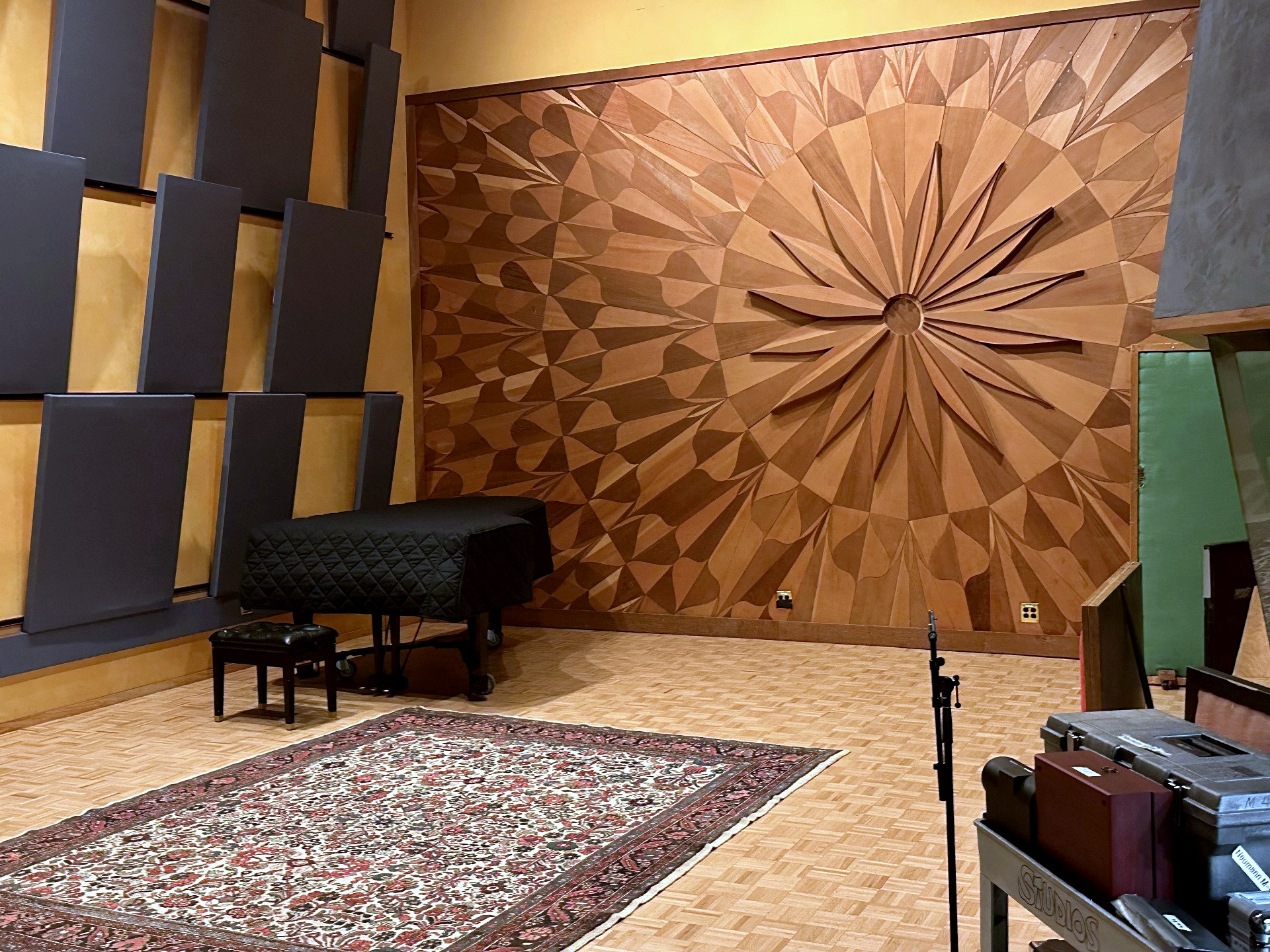 Photo by Tom Proctor