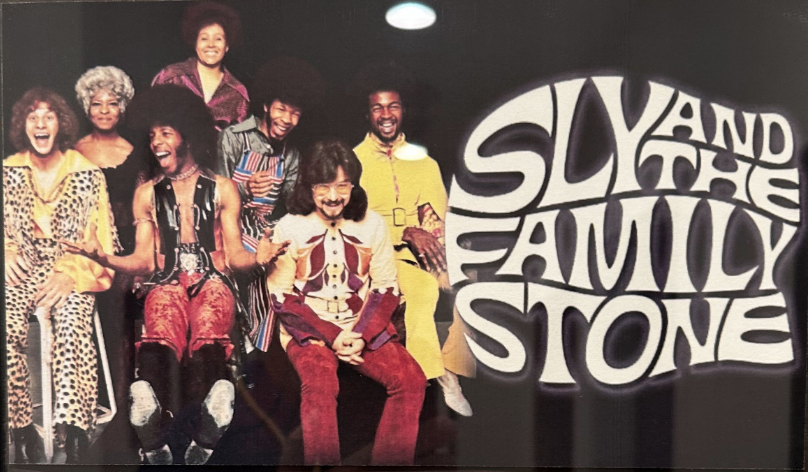
Sly & the Family Stone at Record Plant Sausalito
Sly Stone commissioned a room at Record Plant Sausalito built to his exact specifications. Then he moved in. The room is still underneath the studio that replaced it.
By Tom Proctor
Sylvester Stewart grew up thirty minutes from the building he'd eventually live in. He was born in Denton, Texas, and raised in Vallejo, across the bay from Sausalito. By the time Record Plant opened its doors in late 1972, Sly Stone was already home.
The Bay Area's Own
Before the band, before Woodstock, before any of it, Sly was a Bay Area radio personality. He worked as a DJ at KSOL in San Francisco and later at KDIA in Oakland. He mixed Black artists with the Beatles and the Rolling Stones on the air. Nobody in Bay Area radio had crossed that line before, and listeners noticed immediately. He produced records for Autumn Records in San Francisco before he turned twenty-five. Bobby Freeman's “C'mon and Swim” reached number five nationally in 1964. Sly produced that single while still working the evening shift at the station.
He and his brother Freddie merged their bands in 1966 and formed the Family Stone. The group was racially integrated and mixed-gender, a genuine first in American rock. They played at Winchester Cathedral in Redwood City and built a local following fast. Then Columbia Records showed up with a contract, and Sly left radio for good.
The Rise
By 1968, “Dance to the Music” was a top ten hit across the country. “Everyday People” went to number one on the Billboard chart and stayed there. The band's fusion of soul, rock, psychedelia, and gospel created something genuinely new. Norman Whitfield at Motown heard it and started rebuilding the Temptations' sound around it. Miles Davis heard it and started rethinking what jazz could absorb from funk.
Then Woodstock happened, and the band played at five in the morning to a massive crowd. Rose Stone described looking out as the sun came up and seeing nothing but people. It was the performance that turned them from a hit act into a cultural force.
The Descent
The years after Woodstock brought assassinations, Vietnam, and a country tearing itself apart. Sly's music shifted with it, moving from euphoria into something heavier and more isolated. There's a Riot Goin' On came out in 1971 and sounded like nothing before it. He recorded most of it alone, replacing band members with overdubs and drum machines. Larry Graham, the bassist who invented slap bass, wasn't invited to play or sing. Graham later said he begged to contribute, but Sly wouldn't let him near the sessions. The album went to number one anyway, driven by “Family Affair” and its stark minimalism.
By 1972, Sly's reputation for missing shows and burning through studio time was well established. He would book sessions and not show up, then arrive unannounced at three in the morning. Record labels found him nearly impossible to manage, but the music kept justifying the chaos.
Coming to Sausalito
The Record Plant opened in Sausalito in late 1972 at 2200 Bridgeway on the waterfront. Gary Kellgren and Chris Stone built it as a retreat from the LA and New York scenes. Sly was one of the first major artists to book time in the new building.
Engineer Tom Flye had come west from the New York Record Plant to run Studio B. Flye helped Sly and the Family Stone make their album Fresh in the building's earliest days. The sessions were chaotic but productive, and the album captured something remarkable on tape.
Fresh was a reinvention of the band's sound built around a new rhythm section. Rustee Allen, nineteen years old, replaced Larry Graham on bass and brought a different approach. Allen's bassline on “If You Want Me to Stay” became one of the defining grooves of the decade. Miles Davis came by the sessions just to watch Sly work and made his own group listen on repeat. Brian Eno later praised how Sly repositioned bass and drums within the mix on Fresh. That production choice influenced a generation of producers and engineers who heard it.
Sly being Sly, the album was nearly finished when he decided to start over entirely. Flye recalled that Sly booked a day, came up from LA with a big entourage in tow. They re-recorded roughly ninety percent of the album and mixed it in that single session. The version that shipped in June 1973 was a masterpiece that had been made twice.
The Pit
Sly spent so much time at the Plant that Kellgren and Stone built him his own room. They converted an office space into something no other studio in the world contained. The engineers called it the Pit, and the name stuck permanently to the architecture.
The room measured roughly 140 square feet, small by studio standards but intentionally so. The engineer's console sat ten feet below the main floor, sunk into the building's foundation. Musicians played on the ledge above it, looking down at the controls below them. Bright maroon plush carpet covered every surface: the floors, walls, ceiling, and stairs. There were no windows and no concession to what a recording studio was supposed to look like. The room was acoustically dead in a way that felt visceral rather than clinical. Images of the space are scarce. One image exists that's a not-so-clear black and white showing Sly at keyboards and Bill Wyman standing there, with a cluttered background where you can see folding chairs up a level. The image is licensed to Getty Images and they want $400 just to show it. We love the resource, but they cost too much for a site like this. The image isn't good enough anyway, but here's a link to a FB post with it if you're curious.
Adjacent to the studio, they built Sly a bedroom with a loft bed above the space. You reached the bed by climbing through a giant pair of red upholstered lips. The lips were an homage to his grin, and they were exactly as strange as they sound. Audio jacks at the head of the bed connected a microphone directly to the console below. He could record vocals from under the covers without ever leaving the bed.
Record Plant Sausalito. Same spot where Stevie Nicks wrote Dreams.
Sly moved into the building and started treating the Plant as his permanent address. He wanted all the doorknobs in his area raised, about a foot higher than standard placement. Staff engineer Jim Gaines eventually changed them back because he couldn't deal with it anymore. Gaines later said there were more stories he probably shouldn't tell about that period.
The only way to reach Studio B in those early days was through Studio A. When Sly showed up early for his night sessions, he'd walk straight through whatever was happening. He'd stroll through a New Riders of the Purple Sage session in full regalia without pausing. Flye described him walking through other artists' sessions in stage clothes without breaking stride.
What Came After
Small Talk followed in 1974, with sessions that drew partly on the Plant's familiar rooms. By 1976, Sly was recording Heard Ya Missed Me across multiple Bay Area studios. String parts and late-night sessions still took place in the Pit at the Sausalito location. The room remained his space even as the rest of his career started to fracture.
That same year, Fleetwood Mac booked Studio B to record the album that became Rumours. Stevie Nicks wandered down the hall one afternoon and found the Pit unoccupied and quiet. She sat on Sly's bed with a Fender Rhodes keyboard and a cassette player running. Ten minutes later she had “Dreams,” which became Fleetwood Mac's only number one single in America. She wrote the biggest hit of her career in a room built for someone else entirely.
Later, Rick James arrived and took up residence in the conference room with the waterbed floor. Studio manager Shiloh Hobel described the moment Sly dropped by and met James for the first time. She called it an incredible meeting between two fabulous forces in music, each genuinely taken with the other. The building kept drawing people who wanted to live inside the work.
The Room Today
When Frager's team excavated the space during the Garden renovation, they found the original concrete pit intact. They didn't fill it in or demolish it. They built two massive subwoofer enclosures directly into the void, flush with the floor slab. The acoustician, Manny LaCarrubba, described the concrete as sitting on grade with no direct coupling to the building structure. The earth itself became the vibration sink. Sly's pit became the foundation for a new monitoring system that nobody in the room above could see.
The evidence is still visible if you know where to look. Sections of the Garden's floor are covered with boards laid over sub-floor voids rather than solid slab. Lift those boards and you're looking at the space where the engineer's console once sat ten feet below the musicians. The room didn't erase what Sly built. It buried it and kept recording.
The maroon carpet is still on the walls of the hallway leading to the room. The giant red lips and the bed are gone, but the proportions of the space still carry the original geometry. Walk through the Garden today and you're standing on top of one of the strangest rooms ever built for a single artist. The Pit didn't disappear. It just went underground.
Every article on this site has mentioned the Pit without ever telling the full story of who built it and why. The room has been a supporting character in six different pieces, referenced in passing, borrowed by Stevie Nicks, inherited by Arne Frager, and quietly buried under a new floor. This is its story.
Sly
Sly Stone died on June 9, 2025, at his home in Los Angeles at the age of eighty-two. He'd been battling chronic obstructive pulmonary disease and other health issues for years. His family said he passed peacefully, surrounded by his children and his closest friends. He completed a screenplay about his life shortly before he died, and his family plans to share it.
The Questlove documentary Sly Lives! came out the same year, exploring the weight of genius and fame. The memoir Thank You (Falettinme Be Mice Elf Agin) had arrived in 2023, his own words finally. He was inducted into the Rock and Roll Hall of Fame in 1993 with the Family Stone. He received the Grammy Lifetime Achievement Award in 2017 after decades out of the spotlight.
The building at 2200 Bridgeway has outlived many of the artists who made it legendary. But it still carries their decisions in its walls, its floors, and its architecture every day. The Pit exists because Sly Stone wanted a room that felt like nowhere else on earth. He got exactly that, and then he moved in, and the building has never been the same.
Plant Radio is dialed to stream 64 historic KSAN and KFOG broadcasts like Steve Miller, Fleetwood Mac, Bob Marley, Bonnie Raitt, Journey, Jerry Garcia, and many more surprises.
Turn on the radio- 2200 StudiosThe Record Plant Sausalito: 1972–2008
- 2200 StudiosHow Stevie Nicks Wrote “Dreams” at Record Plant Sausalito
- 2200 StudiosRick James & “Street Songs”: Inside the Record Plant Sessions
- Ultimate Classic Rock50 Years Ago: Why Sly Stone Couldn't Leave 'Fresh' Alone
- KQED ArtsRunning the Record Plant, Part 1
- Folkrocks / Richie UnterbergerThe Record Plant in Sausalito
- Jim WelteCall of the Wild: The Rise & Fall of the Record Plant Studio
- Porter, Martin and Goggin, David. *Buzz Me In: Inside the Record Plant Studios.* Thames & Hudson, 2024.
- Selvin, Joel. *Sly & the Family Stone: An Oral History.* 2022.
- Stone, Sly and Greenman, Ben. *Thank You (Falettinme Be Mice Elf Agin): A Memoir.* AUWA Books, 2023.
- KQED Arts — Running the Record Plant, Part 1: The Early Years (September 2024).
- Folkrocks / Richie Unterberger — The Record Plant in Sausalito (February 2017).
- Thelen Creative, "Sly's Last Epic Album." February 2023.
- Ultimate Classic Rock — 50 Years Ago: Why Sly Stone Couldn't Leave 'Fresh' Alone (June 2023).
- Hi-Fi News, "The Record Plant, Page 2." March 2025.
- Mix Magazine, "The Plant." August 1999.
- NPR, "Sly Stone, visionary funk frontman, has died at age 82." June 2025.
- 2200 Studios History.
- AES LA Podcast Transcript, *Insights and Sound*, 2024.