In the summer of 1999, Mariah Carey was working in a studio above the water on Capri. An October Interview conversation reached her there, in the middle of recording Rainbow. Carey later explained that the island gave her the isolation needed to complete the album in three months.
At nearly the same moment, 2200 Bridgeway was running at full capacity. When Mix visited the Sausalito studio in mid-June, Kenny Wayne Shepherd was recording vocals in Studio B. Third Eye Blind was tracking in Studio A, while Primus mixed in the new Garden room.
The two scenes belong to the same recording year. The available evidence does not place Carey in the Sausalito one.
That distinction matters because the original claim sounds plausible. Carey had worked at The Plant before. Arne Frager was operating the Sausalito facility in 1999. Album databases often reduce the Rainbow location credit to “Record Plant,” leaving readers to choose among studios in New York, Los Angeles and Sausalito.
The detailed credits point south.
What the Rainbow credits show
Carey recorded Rainbow across a network of studios during 1999. The album credits name rooms in Capri, New York, Minnesota, Atlanta and Southern California. A catalog transcription of the 1999 US pressing identifies the relevant facility as “Record Plant, Los Angeles.” It lists that studio under recording, engineering and mixing.
The track-level credits make the location clearer.
“Heartbreaker” was assembled across Capri Digital, O’Henry Sound, Quad, Record One, Right Track and the Los Angeles Record Plant. The credited producers were Carey, DJ Clue and Ken “Duro” Ifill. Dana Jon Chappelle and Duro received engineering credits.
“How Much,” featuring Usher, was recorded at Capri Digital, KrossWire Studio in Atlanta and the Los Angeles Record Plant. Its mix was done at Silent Sound in Atlanta, not at Record Plant Sausalito. The album credits name Carey and Jermaine Dupri as producers, Bryan-Michael Cox as co-producer and Brian Frye as engineer.
“After Tonight” also passed through several rooms. Its credits include Capri Digital, Cello Studios, Chartmaker, Quad, Right Track and the Los Angeles Record Plant. It was mixed at the Los Angeles facility by Humberto Gatica. Carey and David Foster produced it; Dana Jon Chappelle, Felipe Elgueta and David Reitzas received engineering credits.
“Crybaby,” featuring Snoop Dogg, was recorded at Capri Digital and Right Track. Its credited mixes were made at Quad and the Los Angeles Record Plant.
These are recording and mixing credits, not proof that every performer attended every listed room. They also do not provide individual session dates. What they establish is that the Record Plant named in Rainbow’s production trail was in Hollywood.
No reviewed album credit, session log, trade report or participant interview places any Rainbow work at 2200 Bridgeway.
Carey’s actual Sausalito history
Carey’s connection to the Sausalito studio began earlier.
“Love Takes Time,” added late to her 1990 debut album, was recorded at The Plant in Sausalito and the Hit Factory in New York. It was mixed in Sausalito, according to the song’s album-derived credits. Those credits name Dana Jon Chappelle as engineer and mixer, David Frazer as mixer and Manny LaCarrubba as an additional engineer.
Walter Afanasieff later described the hurried route taken by the song. Music was prepared, Carey recorded her vocals in New York, and Afanasieff and Chappelle returned west with the tape to mix it in Sausalito. His account describes a production moving between specialists and rooms under deadline, rather than an artist settling into one studio for an album-length lockout.
The Music Box credits provide another verified connection in 1993. “Hero” lists both The Plant Studios in Sausalito and the Los Angeles Record Plant among its recording locations. The vocal recording and mix were credited to Right Track in New York. The title track lists Right Track and The Plant in Sausalito for recording, with mixing at Sony Music Studios in New York.
This earlier work probably helped attach Carey’s name to the Sausalito studio in later histories. KQED’s oral history of the Frager era names her among the artists who held sessions there. It does not identify Rainbow, a date or a room.
That general association cannot override a location-specific album credit.
What Sausalito was selling in 1999
Frager had joined the studio’s ownership in 1988. By 1999, he was selling more than an isolated recording room. The Plant offered large tracking spaces, specialized consoles, overdub rooms, a new surround-capable mix room and the practical seclusion of Marin County.
Studio A had been substantially rebuilt during the 1990s. The Record Plant Sausalito Archive’s room documentation dates the raising of its ceiling from 14 to 32 feet to Frager’s renovation for Metallica. In June 1999, Mix found Third Eye Blind using the room for tracking.
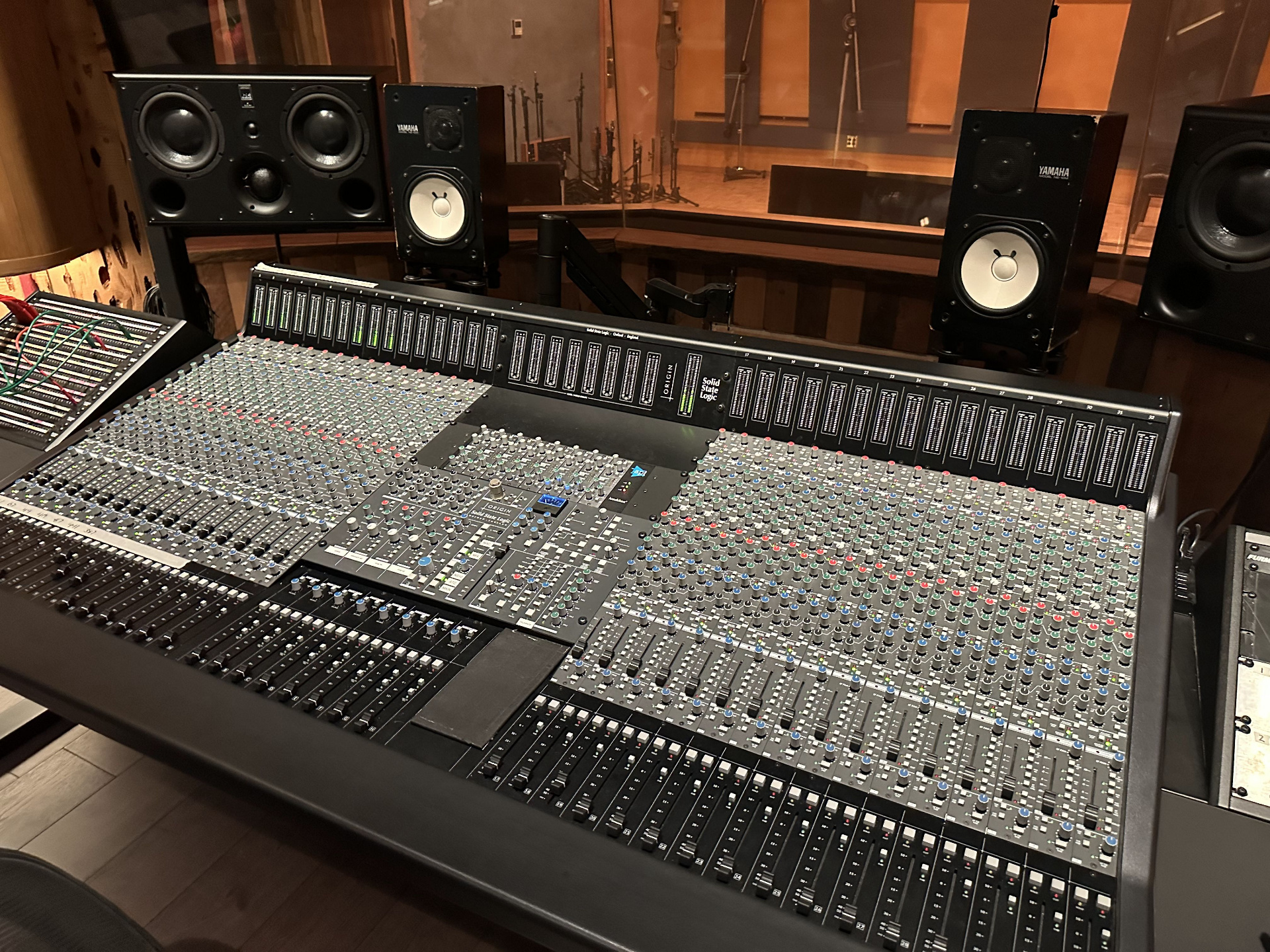
Studio B carried a 64-input Neve 8068 with GML automation. A contemporary studio directory described three isolation booths, adjustable floor-to-ceiling drapes and 1,200 square feet of fabric-covered ceiling clouds. The June 1999 Mix visit found Shepherd recording vocals there.
Those facts explain what the rooms could provide for vocals, overdubs and ensemble tracking. They do not establish that Carey used either room for Rainbow. No source reviewed for this article assigns her to Studio A, Studio B or the Garden in 1999.
Frager was also trying to keep work in the Bay Area after basic tracking. He told Mix that the Garden represented an investment in local mixing because projects had often left for New York or Los Angeles at that stage. The room used an SSL 8096 G Plus console and a small adjoining overdub space.
In other words, Sausalito was built to handle exactly the kind of distributed major-label production represented by Rainbow. The record simply appears to have used the Los Angeles branch instead.
The last commercial decade
The June 1999 scene at 2200 Bridgeway is better evidence of The Plant’s late business than an unsupported Carey booking. Three projects occupied three rooms for three different jobs: vocals, tracking and mixing. Frager was investing in a fourth room for mastering while developing label and management operations.
By 2003, the economics had changed. Frager told Mix that The Plant had endured three difficult years. He was reducing overhead, pursuing managers and labels in Los Angeles, and packaging studio time with Sausalito houseboats and catering. He described the studio’s core business as making pop albums rather than commercials, voice-overs or film mixes.
KQED’s later oral history records Frager’s account that the studio began losing money in 2000. He sold it in 2008, and recording operations ended shortly afterward. Mix likewise dates the Sausalito closure to 2008.
The closure removed more than a group of microphones and consoles from the market. It ended the ability to book a staffed, multi-room album operation at 2200 Bridgeway: track a band in A, move vocals or overdubs into B, and finish a mix elsewhere in the same building.
The surviving rooms still show what that operation could do. They do not turn a Los Angeles credit into a Sausalito session.
Open questions
Do Sony’s surviving session logs identify dates, personnel and work performed at the Los Angeles Record Plant for each Rainbow track?
Does any 1999 invoice, tape box, recall sheet or Sausalito studio calendar place Carey or a Rainbow reel at 2200 Bridgeway?
Which room or rooms did Carey use during her verified 1990 and 1993 Sausalito work?
Did Carey return to Sausalito for another documented project after Music Box?
Can the location labels in the available Rainbow credit transcriptions be checked directly against a complete scan of the original US booklet?