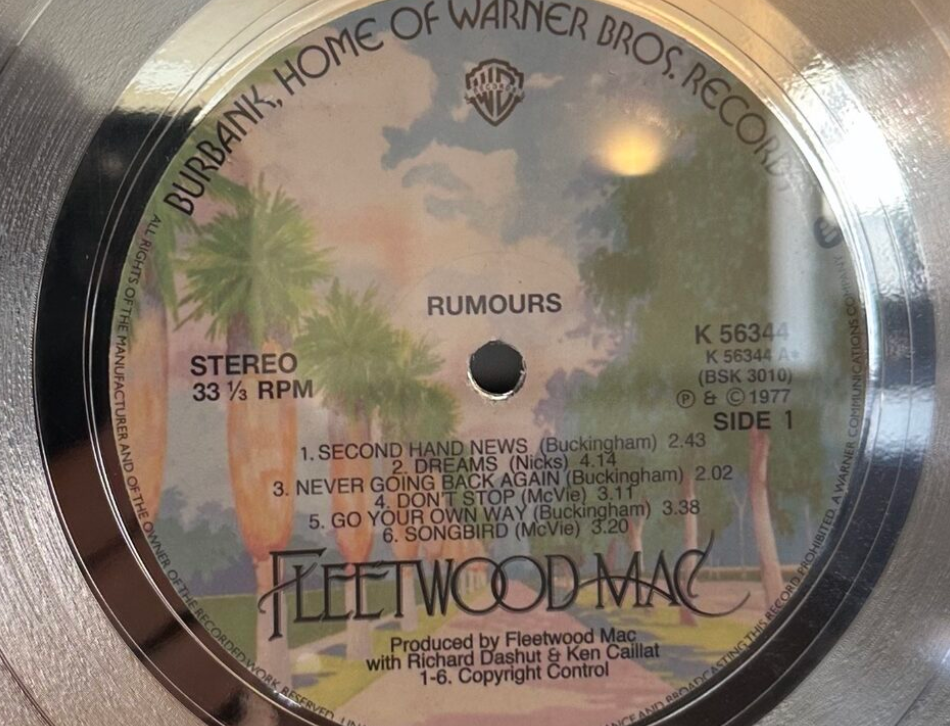
Fleetwood Mac at the Record Plant
Two nights, two bands, one room.
By Tom Proctor
Fleetwood Mac walked into the Record Plant in Sausalito twice, two years apart, as two different bands. The first time, in December 1974, they were a battered lineup on its last night together, fighting in court against a fake version of themselves. The second time, in 1976, they were the most combustible group in America, about to make one of the best-selling records ever pressed. Same building. Same rooms. The story of Fleetwood Mac at 2200 Bridgeway is really the story of how one band became another without ever changing its address.
December 15, 1974: the real Fleetwood Mac stands up
By late 1974 Fleetwood Mac barely had a fixed shape. Peter Green, the founder, was four years gone, lost to LSD and mental illness. Guitarist Danny Kirwan had been fired. Bob Weston had been fired too, mid-tour, after Mick Fleetwood learned Weston was having an affair with his wife. What was left was Bob Welch carrying most of the singing and songwriting, Christine and John McVie, Fleetwood on drums, and a touring keyboardist named Bobby Hunt filling in on Hammond organ, clavinet, and synthesizer. Hunt had replaced Doug Graves — the band's own assistant engineer, who'd been pressed into service on keys — partway through the tour. He was never a full member. He just happened to be the man at the organ the night the tape rolled.
The band had spent much of that year in law offices instead of studios. Their former manager, Clifford Davis, had decided the road-weary group owed him a tour, and when they refused, he claimed he owned the name outright. He assembled an entirely bogus Fleetwood Mac — not one real member — and sent it across the United States. The real band found out while on holiday. “Before the bogus band played too many dates,” Fleetwood told Rolling Stone, “we had to physically get together and take legal advice. The impression Clifford had given was that he had every legal right to do what he did. We very soon found out apart from morally having no excuse, there was no legal right.” An injunction stopped the fake band by April. The imposters regrouped under the name Stretch and scored a UK hit built, Fleetwood said, on a lyric attacking him personally.
That's the weather the December 15 broadcast came out of. KSAN's Tom Donahue introduced the set to a small live audience with a line that only makes sense against the lawsuit: “They have had imitators. They've had even forgeries, but this is the real Fleetwood Mac.”
Then the band did something quietly remarkable. They opened not with a Welch song or a track off their new album, but with “The Green Manalishi (With the Two Prong Crown)” — the last song Peter Green ever wrote for the band before he left, a piece born from a drug-induced nightmare about the evil of money and success. Over the next hour they returned to Green's shadow again and again: “Black Magic Woman,” which Santana would make famous, and “Oh Well,” Green's most ambitious composition. On the night they were fighting to prove they were the authentic Fleetwood Mac, they spent it honoring the man who started it and then vanished. Around all that sat their own era's songs — Christine McVie's “Spare Me a Little of Your Love,” Welch's dreamy “Hypnotized,” “Sentimental Lady,” “Future Games,” “Bermuda Triangle.”
The set ran eleven titles in about seventy-two minutes. It survives, and it was officially released decades later on Rhino's Fleetwood Mac 1969-1974 box set, so you can hear the whole thing. The full broadcast has its own page in the archive.
Weeks after this broadcast, Welch quit. He was exhausted — he'd become the band's only guitarist and had written most of their last album — and his marriage was failing. It was Welch, ironically, who had pushed the band to move to America in the first place. He left just before America made them enormous. When Fleetwood Mac was inducted into the Rock and Roll Hall of Fame in 1998, the ceremony centered on the lineup that came after him; Welch wasn't included. He died in 2012. “He was a huge part of our history,” Fleetwood said, “which sometimes gets forgotten.”
1976: the same room, a different band
Fourteen months later, Fleetwood Mac came back to the Record Plant. Welch was gone. In his place were two Californians, Lindsey Buckingham and Stevie Nicks, and the band that had been fighting for its life in 1974 was suddenly on the verge of enormous success. They chose the Record Plant on purpose: cross the Golden Gate, leave Los Angeles behind, and hole up together in one building until an album came out of it. They stayed the better part of a year and made Rumours, which sold more than forty million copies and won Album of the Year.
The production team came together almost by accident, and it started with a firing that rhymes with 1974. The Record Plant's own house engineer didn't survive the first week — co-producer Richard Dashut says the man was let go after four days for being, in the band's judgment, too into astrology. So Mick Fleetwood walked Dashut out to the parking lot, put an arm around his shoulder, and informed him he was producing the album now. Dashut, who had never produced anything, called his friend Ken Caillat for backup. Fleetwood handed the two of them an old Chinese I-Ching coin and wished them luck.
The building was built for a long, indulgent stay. Nautical wood everywhere, psychedelic murals, velvet clouds on the walls, a jacuzzi, a game room, tennis courts out back, a speedboat at the dock, and a conference room with a waterbed for a floor. The kitchen would make hash cookies if you asked. The drugs weren't a Fleetwood Mac invention, they were a Record Plant fixture — the place had been built around indulgence, cocaine included, since Sly Stone camped out in a red-shag sunken room here called the Pit. Three studios ran at once, so the halls were a revolving door of famous drop-ins: Van Morrison hung around, Rick James and Chaka Khan came through, and Jackson Browne turned up with Warren Zevon because Browne wanted Buckingham and Nicks to sing on his own record.
The songs got built out of whatever was in the room
The opening track came together fast and strange. “Second Hand News” needed a rhythm Buckingham couldn't describe, so he mimed it in the control room — Caillat said it looked like Lindsey was “showing Mick how to kill a snake with his bare fists,” screaming the beats out loud, arms flailing. After five or six tries, Fleetwood gave up and just had Buckingham play the part himself. For the song's thumping backbeat, Buckingham sat down and drummed on a leather chair. The whole thing was his attempt to chase the rickety funk of the Bee Gees' “Jive Talkin'.”
“Go Your Own Way” got its signature stumble the same way. Driving into the studio one morning, Buckingham told Dashut he loved the loose, off-kilter drum fills Charlie Watts played on the Rolling Stones' “Street Fighting Man.” He wanted something like it. He demoed the idea by whacking Kleenex boxes. Fleetwood tried to copy it, never quite landed it, and his “mutated interpretation,” as he called it, became one of the most recognizable drum parts in rock.
Then there's “Gold Dust Woman,” where the album's sense of humor and its darkness collide. To sharpen the sound behind Nicks's vocal, Fleetwood put on safety goggles and coveralls, stood in a mic'd room with a big hammer, and smashed sheets of plate glass. Caillat's memory of it is affectionate: “He just went mad, bashing glass with this big hammer. He tried to do it on cue, but it was difficult. Eventually we said, ‘Just break the glass,’ and we fit it all in.” Nicks cut her vocal around four in the morning, a black scarf tied around her head, nursing a sore throat with a Vicks inhaler, throat lozenges, and mineral water lined up beside her. It took eight takes. She said she wanted to feel like she was singing in an empty church. The song reaches for the thing running through the whole building: Nicks later confirmed “gold dust” was a metaphor for cocaine, and what started as a song about someone else would become, in the years after, closer to home.
Nicks's songs tended to arrive at ten or twelve minutes long, dense with verses, and a lot of Caillat's job was cutting them down. She fought him on it. “Stevie would go crazy,” he remembered. “‘Oh, that verse was about my mother! That part was about my dog!’” The details meant everything to her. They still had to fit on a side of vinyl.
The best song on the record came from a bed nobody was using
One afternoon Nicks wasn't needed on the main floor, so she let herself into an abandoned studio down the hall that had belonged to Sly Stone. By her own description it was a red-and-black room with a sunken pit, a piano, and a big black velvet bed under Victorian drapes. She sat on the bed with a Fender Rhodes, found a drum pattern, switched on her little cassette recorder, and wrote “Dreams” in about ten minutes. She brought it to the band the next day. It became the only Fleetwood Mac song ever to reach number one.
Christine McVie had a smaller miracle of her own. She'd walked into the sessions sure she was out of songs. Then she sat down at a piano one day, and, as she tells it, four and a half of her songs on the record simply came out of that afternoon. One of them, “You Make Loving Fun,” produced the most Fleetwood-Mac moment of the whole year: Buckingham and Nicks, freshly broken up, leaning into a shared microphone to sing gorgeous harmonies, then hurling insults at each other the instant the tape stopped to rewind. “Two little angels,” Caillat said. “The tape would stop and they'd be calling each other names again. They didn't miss a beat.”
The Chain, and a name for all of it
The album's one true group composition happened by accident, early. On February 2 the band ran a Christine McVie song called “Keep Me There.” Two passes went nowhere. On the third, John McVie played a bassline nobody had asked for, and everybody kept it. The finished track ended up stitched together from pieces cut weeks apart — a bridge from here, verses added later, only the original ending left intact. That patchwork is why they called it “The Chain.” It's the only song credited to all five of them, and it exists because they saved the good parts and welded them together.
When it came time to name the record, it was John McVie who landed on it — not a grand concept, just a plain read on what the previous nine months had been. Even the cover carried a private joke: the wooden balls dangling from Fleetwood's costume were toilet chains he'd swiped from a club years earlier, after a couple of English ales.
The room keeps the good parts
Studio B is still there, mural and all — the one nobody can decide is clouds or balloons. Ken Caillat, back in the building decades later, can still point to where everything stood: Fleetwood's drums on one wall, McVie's bass rig on another, Christine's piano and Rhodes in the corner, Buckingham over by the red curtain.
Two years before any of them stood there, another Fleetwood Mac had played its last night in the same building — a band fighting to prove it was real, opening with the founder's saddest song. The room held both. It doesn't tell you which version was the real Fleetwood Mac. It just kept the tape.
Plant Radio is dialed to stream 64 historic KSAN and KFOG broadcasts like Steve Miller, Fleetwood Mac, Bob Marley, Bonnie Raitt, Journey, Jerry Garcia, and many more surprises.
Turn on the radio- 2200 StudiosThe Record Plant Sausalito: 1972–2008
- 2200 StudiosFleetwood Mac Before Rumours: Bob Welch’s Possible Last Night
- 2200 StudiosHow Stevie Nicks Wrote “Dreams” at Record Plant Sausalito
- 2200 StudiosThe Sound of a Room
- Katiana Giacona · BookRecord Plant, Sausalito Studios
- GRAMMY MuseumMaking Rumours — Ken Caillat at the GRAMMY Museum
- GRAMMY.comKen Caillat Revisits Fleetwood Mac's Rumours
- Vintage King40 Years of Excess: The Recording of Fleetwood Mac's Rumours
- WikipediaRumours (album)
- Ken Caillat at the GRAMMY Museum — on recording "Songbird"
Caillat on the mic choices and the unusual Zellerbach Auditorium session that produced Songbird.
- Fleetwood Mac: Unbroken Chain (2004 Documentary)
A candid profile of the band's inner dynamics during and after the Rumours year.
- Fleetwood Mac 2001 Documentary
Band history from the early blues years through the Rumours era and beyond.
- Ken Caillat & Steve Stiefel, *Making Rumours: The Inside Story of the Classic Fleetwood Mac Album* (Wiley, 2012).
- Rumours (album) — Wikipedia)
- Ken Caillat Revisits Fleetwood Mac's Rumours — GRAMMY.com
- Classic Albums: Rumours (documentary, 1997)
- Mick Fleetwood, interview with Q magazine, 1997.
- KSAN broadcast, Record Plant Sausalito, December 15, 1974 — Internet Archive FM Radio Archive